
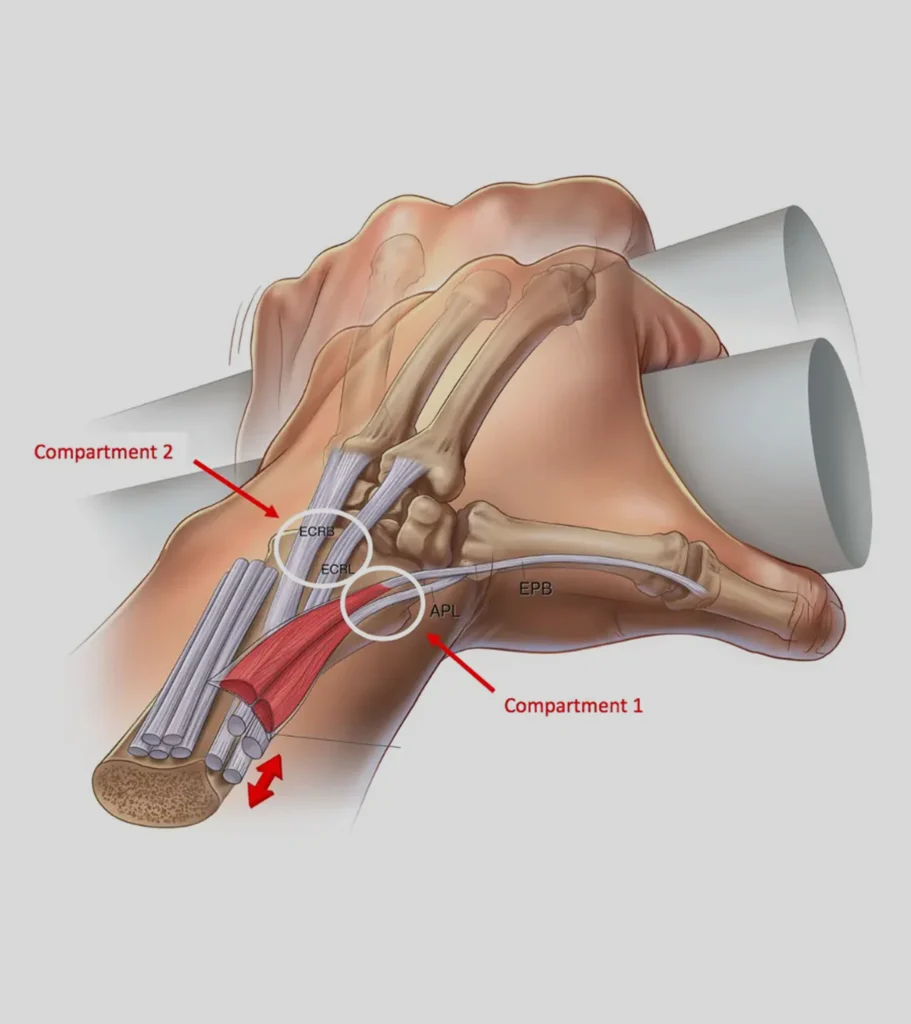
Intersection syndrome is a painful overuse condition affecting the tendons on the thumb/back side of the forearm, near the wrist. It occurs when the tendons that move the thumb (compartment 1) cross over the tendons that extend your wrist (compartment 2), causing friction and irritation of the tendons. This leads to friction and swelling in that “intersection” area, about 2–4 inches above the wrist on the back of the forearm.
Common symptoms include pain on the back of the forearm near the wrist (thumb side), which worsens with activities like gripping, lifting, or twisting the wrist. You may notice swelling, a creaking or squeaking sensation (crepitus) when moving the wrist or thumb, and sometimes redness. Pain often radiates up the forearm and makes tasks like rowing, weightlifting, texting, or skiing uncomfortable.
The main cause is overuse from repetitive wrist and thumb movements, especially those involving forceful extension or flexion. This is common in sports like rowing, canoeing, weightlifting, downhill skiing, racquet sports, or even jobs/activities with heavy gripping or repetitive motions (such as frequent typing or using tools).
Treatment usually starts with non-surgical approaches, which work well for most people, especially in milder or early cases.
Treatment usually starts with non-surgical approaches, which work well for most people, especially in milder or early cases.
Physical therapy with gentle stretching and strengthening can help, and corticosteroid injections into the affected area often provide significant relief. Non-surgical treatments succeed in relieving symptoms in about 60–80% of cases, with improvement often seen in 4–6 weeks (sometimes faster with injections).
This typically involves releasing the tight tendon sheaths (decompression or tenosynovectomy) to reduce friction and inflammation.
Surgery has a very high success rate, often reported as 90–100% for symptom relief in refractory cases, with many patients returning to full activity quickly.