
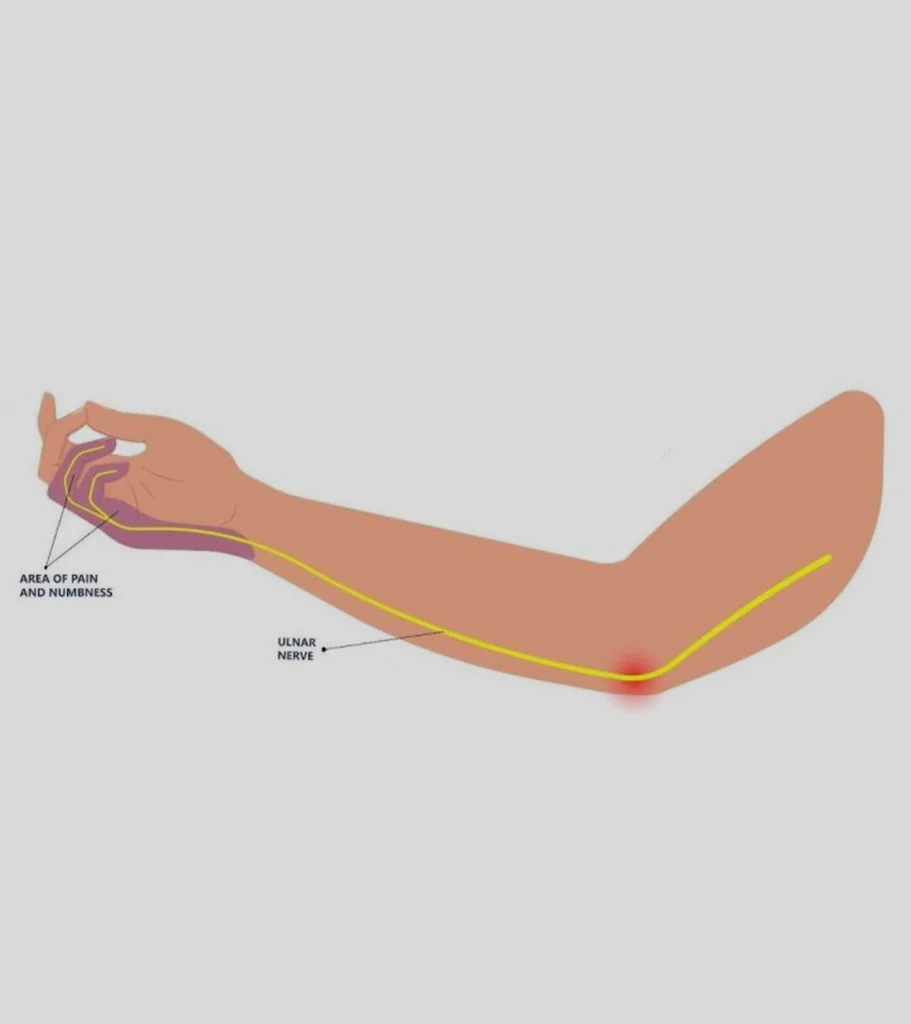
Cubital tunnel syndrome is a condition where the ulnar nerve—one of the main nerves running from your neck to your hand—gets squeezed or irritated at the inside of your elbow. This nerve helps control hand muscles and skin sensations in your hand and fingers. It’s similar to carpal tunnel syndrome but affects the elbow instead of the wrist. When the nerve is compressed, it can disrupt signals, leading to discomfort.
Common signs and symptoms include numbness or tingling in the ring and little fingers, especially when bending the elbow (like during sleep or phone use).
You might feel aching pain around the elbow that radiates to the forearm. In more severe cases, hand weakness can make it hard to grip objects, and muscles in the hand may waste away over time. If left untreated for too long, this muscle weakness can become permanent.
Several factors can contribute to cubital tunnel syndrome by putting pressure on or stretching the ulnar nerve. Overuse from repetitive elbow bending, such as in jobs involving heavy lifting, pulling, or prolonged phone holding, are common triggers. Leaning on your elbow for long periods, like at a desk, adds direct pressure.
Treatment often starts with non-surgical options, especially for mild cases.
These include resting the elbow, avoiding activities that bend it (like using a phone cradle), and wearing a splint or brace at night to keep the elbow straight.
These approaches are successful in about 50% of mild cases, often relieving symptoms within 2-3 months.
Surgery may be needed. Options include in-situ decompression (releasing the tunnel to free the nerve) or transposition (moving the nerve to a less pressured spot).
Surgery has an estimated success rate of 95% for symptom relief, though full recovery can take months in severe cases.