
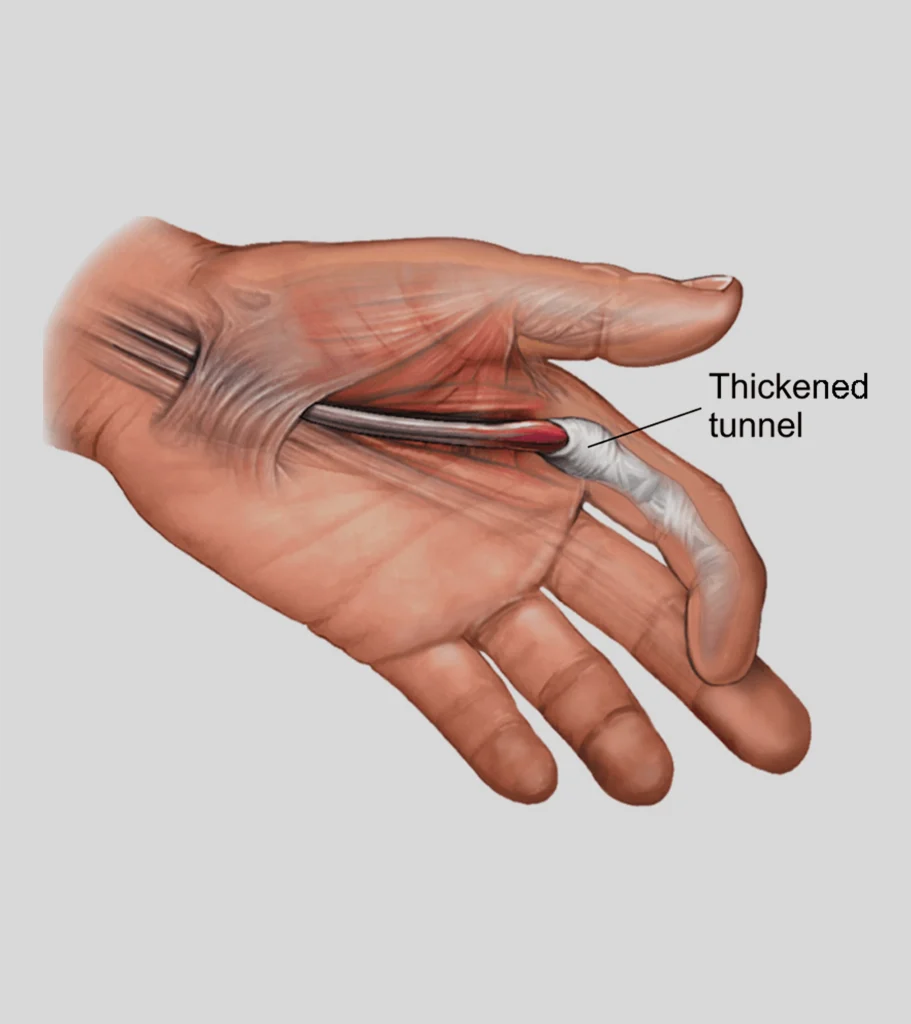
Trigger finger, also known as stenosing tenosynovitis, is a common hand condition where one of your fingers or your thumb gets stuck in a bent position (like pulling a trigger) and then snaps straight again. This happens because the tendons that bend your fingers become irritated and swollen, making it hard for them to slide smoothly through a narrow tunnel (sheath) in your hand. It often affects the thumb, ring finger, or index finger, and can happen in one or both hands.
The condition will often start mildly and can worsen over time.
You might feel pain or tenderness at the base of the finger, especially when gripping or bending it. There’s often a popping or clicking sensation, or a small lump you can feel in the palm. In more severe cases, the finger locks in a bent position and needs to be straightened with your other hand.
Trigger finger usually develops from repeated strain on the hand, but several factors can contribute.
Treatment begins with non-surgical methods to reduce inflammation and improve movement, with surgery as a last resort. Success varies by severity and individual factors like diabetes.
Rest your hand by avoiding repetitive tasks and using padded gloves. Wear a splint at night to keep the finger straight, which helps in mild cases.
Corticosteroid injections into the sheath often provide quick relief, with a success rate of about 60-80% for resolving symptoms after one or two shots, though it may be lower in diabetics.
This is done through a small palm incision
95% and a short recovery of a few weeks.