
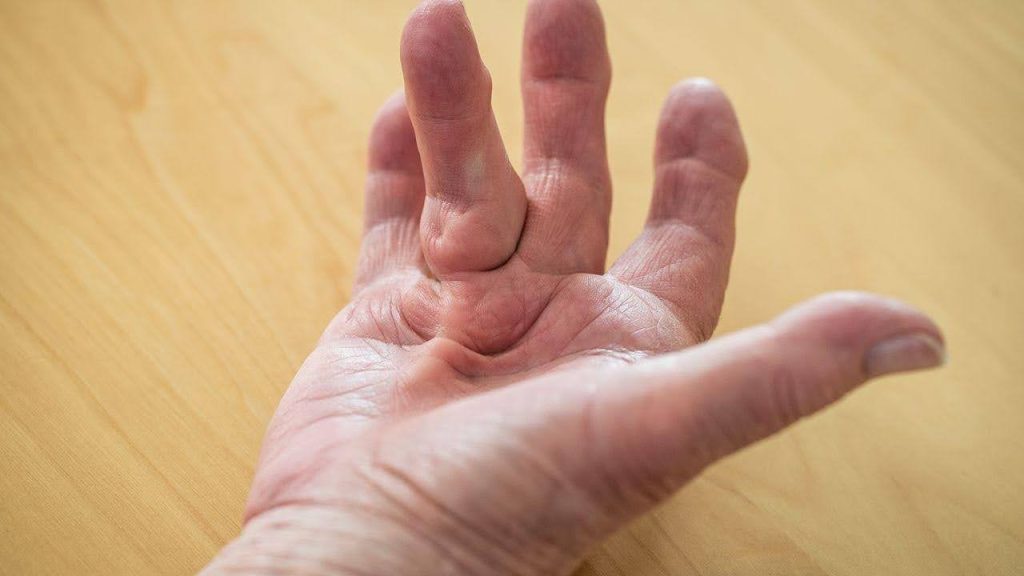
Dupuytren’s contracture is a common hand condition where the tissue under the skin of the palm thickens and tightens over time. This forms lumps (nodules) and thick bands (cords) that pull one or more fingers toward the palm, making it hard or impossible to straighten them. It usually affects the ring and little fingers first and can involve both hands. The condition develops slowly, often over years, and isn’t typically painful, though early lumps may be tender.
Common signs and symptoms include:
It affects about 5% of people, mostly men over 50, and while not cancerous, it can worsen gradually
The main cause is genetics—it’s often inherited and runs in families, with higher risk in people of Northern European or Japanese descent. The condition involves abnormal changes in the hand’s connective tissue, leading to excessive collagen buildup.
Treatment depends on severity; mild cases may just need monitoring. There’s no cure, and recurrence is common with all options.
These are less invasive with quicker recovery and succeed in about 50-75% of cases initially, though recurrence often happens within 3-5 years, and there is risk of nerve injury with needle aponeurotomy.
This is a surgical removal of diseased tissue through an incision. Skin grafts may be required for the surgery.
Surgery has a higher initial success rate of roughly 90%, providing longer-lasting relief, but recurrence affects around 20-40% of people over time. Recovery involves therapy for weeks to months.