
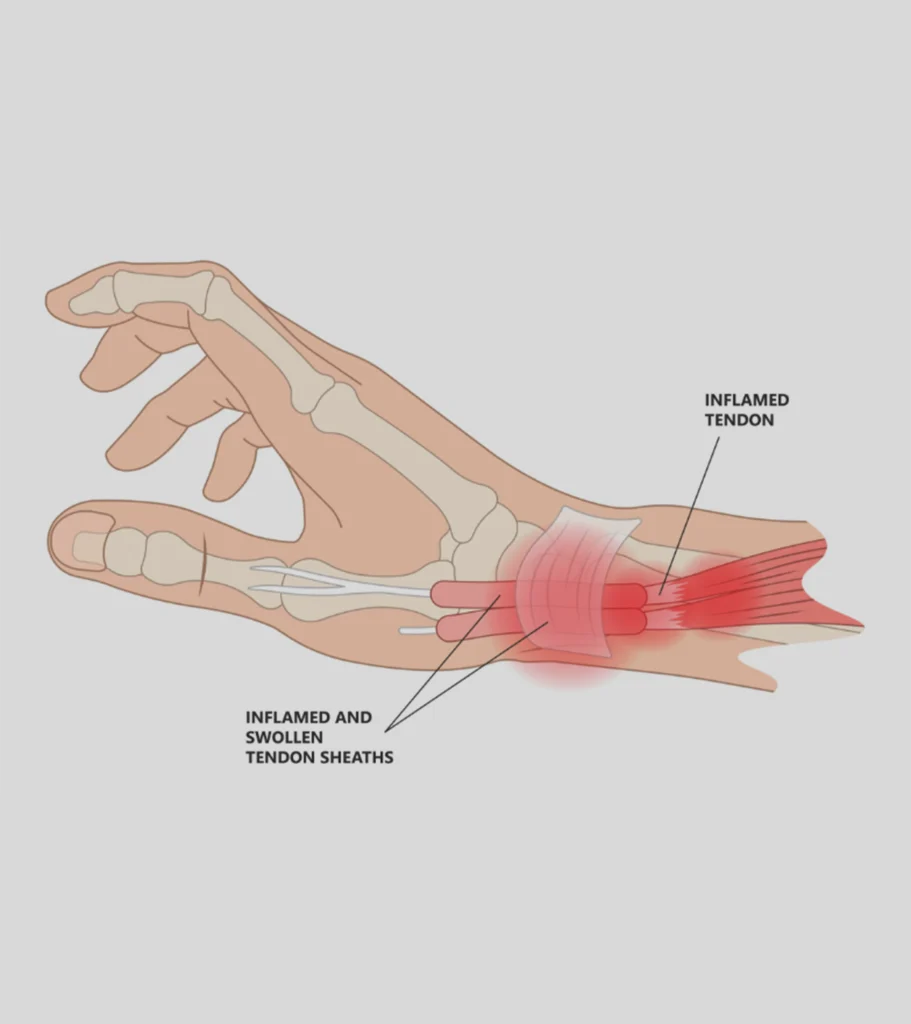
De Quervain’s tenosynovitis is a painful condition that affects the tendons on the thumb side of your wrist. It happens when the sheath (covering) around the two tendons that control thumb movement becomes inflamed and thickened. This makes it hard for the tendons to glide smoothly, causing friction and discomfort during everyday activities.
Common signs and symptoms include:
Many people notice the pain gradually, but it can also start suddenly. A simple test called the Eichhoff test—tucking your thumb into your palm and bending your wrist toward your little finger—often reproduces the pain.
The exact cause isn’t always clear, but the main contributing factor is repetitive overuse of the wrist and thumb, such as from texting, gaming, lifting children, gardening, or certain jobs/hobbies involving gripping and twisting motions. It is more common in labourers.
While some studies suggest a possible genetic link, it’s not a primary cause for most people.
Most cases improve without surgery. Treatment starts with conservative (non-surgical) approaches:
These non-surgical treatments are successful in 60-80% of patients, often providing relief within weeks to months.
Simple operation can be performed to open the tendon sheath (covering.) This involves making a small incision on the side of the wrist, allowing the tendons to move freely.
Surgery has a high success rate of over 90%, with most patients regaining full function and experiencing lasting pain relief. Recovery typically takes a few weeks.